


Are you tired of waking up every day to a job you no longer love? You’re not alone. The traditional corporate 9-to-5 is losing it’s appeal, and more people are looking for careers that offer greater freedom, flexibility and the opportunity to earn a living doing something they genuinely love. If fitness is your passion, becoming a personal trainer (PT) could be the career change you’ve been looking for.
And the timing couldn’t be better.
The UK health and fitness industry is booming, fuelled by a growing focus on wellbeing, healthier lifestyles and preventative care. Gym and fitness spending continues to rise, led primarily by 18 to 34 year-olds, with this age group accounting for 8% of growth as younger generations increasingly prioritise their health over nightlife.
So, what does this mean for you? A huge opportunity to turn your passion into a profession.
The UK alone has around 22,000 gyms, but your career options don’t stop at the gym floor. You could coach clients in boutique fitness studios, work in private facilities, deliver corporate wellness programmes, build an online coaching business or even establish your own fitness brand. Whether you dream of being your own boss, helping others transform their lives or building a career around your own lifestyle, personal training offers a range of exciting possibilities.
And it’s not just a passing trend. From new fitness crazes and emerging training methods to events such as BodyPower EXPO, SFN Expo and Leisure Industry Week, the UK fitness scene continues to evolve. Add the growing influence of social media fitness personalities, and it’s easy to see why becoming a personal trainer is an increasingly attractive career choice.
As more people embrace healthier lifestyles and take a proactive approach to their wellbeing, demand for fitness knowledge, expert guidance and personalised coaching continues to create opportunities for aspiring PTs. The financial potential is attracting attention, too. Statista valued the UK personal training industry at around £850 million in November 2025, while the global market is projected to reach approximately £27 billion by 2033.
For anyone considering a career change, these figures paint an exciting picture of an industry with room to grow, opportunities to specialise and multiple ways to build a rewarding career.
But where do you start?
With the internet, Ai and social media overflowing with advice, figuring out the right qualifications, choosing your career path and knowing how to stand out from the competition can quickly become overwhelming.
That’s where this guide comes in.
Whether you’re starting from scratch, looking to escape the 9-to-5 or ready to turn your existing passion for fitness into a business, we’ll break down how to become a personal trainer, how to stand out in a competitive industry and how to maximise your earning potential.
In this guide, we’ll cover:
- What does a personal trainer do?
- How to become a qualified personal trainer
- How to gain experience and build your client base
- How much can a personal trainer earn in the UK?
- How to increase your earning potential through specialist qualifications
- How group training can help increase your revenue
- The benefits of online and hybrid personal training
- Is becoming a personal trainer worth it?
- How to get started with a personal training qualification
The Role of a Personal Trainer

It’s important to understand the core role of a personal trainer. PT’s work with individuals or small groups to design exercise programs. These programs motivate people and help them reach their fitness goals.
To be a successful personal trainer, you need patience. Many clients come to you because they struggle to stay motivated. Clients may also be struggling with low self-esteem and wanting to escape a rut. Taking into consideration these qualities is important when looking into qualifying as a PT.
Steps for becoming a qualified Personal Trainer
Step 1: Gain Your Level 2 and Level 3 Qualifications
The first step towards becoming a personal trainer in the UK is gaining the appropriate qualifications. This typically involves achieving a Level 2 Gym Instructor qualification followed by a Level 3 Personal Training qualification.
At Diverse Trainers, we offer a fast-track Personal Training Diploma designed to equip you with the theoretical knowledge and practical skills needed to begin your career in the fitness industry. Depending on your starting point, you may be able to complete this combined qualification that covers both levels.
Step 2: Gain Experience and Get Your Foot in the Door
Once you’ve started your training, gaining practical experience should be your next priority.
Visit your local gym, speak to established personal trainers and ask whether you can shadow a session or gain experience in a gym environment. Getting to know other professionals will help you understand what the role involves day to day, from working with clients to managing your schedule.
Choosing a training provider with industry connections can also help you explore employment opportunities once you qualify. At Diverse Trainers we are affiliated with some of the UK’s leading gyms such as Everlast, PureGym, The Gym Group, David Lloyd, JD Sports and Nuffield Health.
Step 3: Decide Who You Want to Train
Personal training offers the opportunity to work with a wide range of people, each with their own goals and challenges. You might want to help new mums return to exercise, support office workers who want to become more active, train sporting individuals or help older adults maintain their strength and mobility.
Identifying your preferred client group early on allows you to research their needs and develop the knowledge required to support them effectively.
It can also help you stand out in a competitive market. Rather than trying to appeal to everyone, you can develop a clear specialism and tailor your services to a specific audience. Alongside your PT qualification with Diverse Trainers you also get 10 free CPD courses, to help you get a head start in your career.
Alongside your 10 free CPD courses, you can take your expertise further with specialist training in areas such as exercise for older adults, pre- and post-natal fitness, and studio cycling.
For aspiring fitness professionals looking to stand out in the industry and get the best value for money, Diverse Trainers offers tailored Personal Training packages designed to help you achieve your career goals.
Personal Trainers Essentials Package
Build a strong foundation for your career with our Personal Trainers Essentials package. Combining the core qualifications you need to get started, this package includes a Level 2 Gym Instructor qualification, a Level 3 Personal Trainer qualification and a Level 4 Nutrition for Weight Management qualification, giving you the skills and knowledge to support clients and kick-start your career in the fitness industry.
Personal Trainers Ultimate Package
Take your career to the next level with our Personal Trainers Ultimate package. Bringing together an extensive range of industry-recognised qualifications, this package is designed to help you stand out in a competitive market. It includes a Combined Diploma in Personal Training, Level 3 Sports Massage, Level 4 Nutrition for Weight Management, Level 4 Strength and Conditioning, Level 3 Exercise Referral and Level 3 Online Coaching.
Step 4: Complete Your Qualification and Prepare to Work
Registering with CIMSPA (Chartered Institute for the Management of Sport and Physical Activity) is a great way to demonstrate your professional status and commitment to industry standards as a newly qualified personal trainer. While CIMSPA membership is not compulsory to work as a personal trainer in the UK, some gyms and employers require it, so it’s worth checking the requirements of the facilities you’d like to work with.
Insurance is the next step, to cover your training sessions with your clients. This can be bought separately through specific companies for Sport and Leisure. Students looking to become a qualified PT with Diverse Trainers get a 30% discount for insure4sport.
A first aid qualification is beneficial but not essential. As you will be working one-to-one with clients, having this qualification can help you manage emergencies and ensure client safety.
Step 5: Build Your Client Base and Start Earning
Once you’re qualified and ready to work, your next priority is attracting clients and developing a reliable source of income.
Consultations, taster sessions and group training are all useful ways to introduce potential clients to your services. Encourage satisfied clients to recommend you to others, build relationships within your local community and maintain a professional presence online.
Diverse Trainers provide all students completing a Level 3 Personal Trainer and Level 3 Personal Training Diploma qualification with a business blueprint to help you understand how to build a client base.
How much can a personal trainer earn in the UK?
Personal trainer earnings vary considerably depending on experience, location, employment type, pricing and the number of clients you train.
Entry-level salaries may start at around £25,000, while more experienced personal trainers can earn around £45,000. These figures should be treated as indicative rather than guaranteed, as employed salaries and self-employed business income are not directly comparable.
For self-employed personal trainers, the amount you earn will depend on how you structure your services and manage your workload.
For example, consider this example revenue model based on tiers:
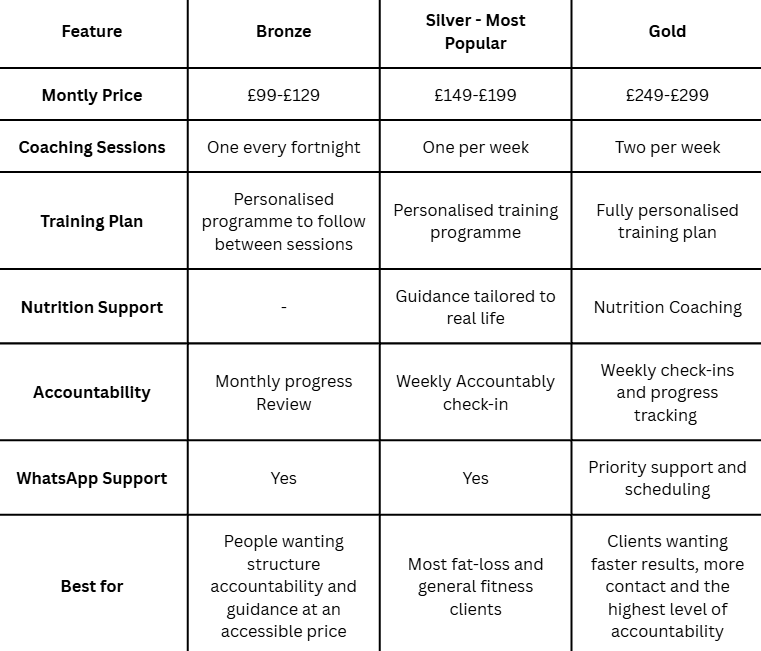
The key takeaway is that your earning potential is influenced by more than the hourly rate you charge. Your ability to attract clients, retain them and offer services that meet their needs can make a significant difference.
How to Increase Your PT Earning Potential Through Specialisation

Once you’ve established yourself as a personal trainer, developing additional skills can help you reach new audiences and expand your services.
Additional qualifications and continuing professional development (CPD) can help you develop expertise in areas such as:
- Nutrition and healthy eating: Develop your understanding of nutrition and support clients within your professional scope of practice.
- Pre- and postnatal exercise: Build the knowledge needed to support clients through pregnancy and the return to exercise after childbirth, with appropriate training and referral where necessary.
- Exercise for older adults: Learn how to adapt exercise sessions to support strength, mobility, balance and independence.
- Exercise and weight management: Develop your ability to support clients with sustainable activity habits and weight-management goals, working within your qualifications and referring to healthcare professionals when appropriate.
- Sports massage: Add a complementary service that may appeal to active clients, subject to the relevant qualification and insurance requirements.
Specialising can help differentiate your business and give clients a clear reason to choose your services. Depending on demand, your experience and the value you provide, specialist services may also allow you to charge higher rates.
You don’t need to gain every qualification at once. Start by considering which client groups interest you most and which additional skills would genuinely benefit the people you want to train.
Introduce Group Training to Increase Revenue
One-to-one personal training is an effective way to provide individual attention, but your income can be limited by the number of sessions you can deliver each week.
Group training offers another way to structure your business. By training five or six people in one session, you can provide a more affordable option for each participant while potentially generating more revenue per session than you would from a single client.
Group sessions can also help clients benefit from shared motivation and a sense of community, making them a useful addition to your overall offering.
Explore Online and Hybrid Personal Training
Another way to grow your personal training business is to combine in-person sessions with online coaching.
Working exclusively in a gym can mean spending much of your time delivering individual sessions. Online services can give you more flexibility to support clients remotely through virtual coaching, training programmes, progress reviews and ongoing guidance appropriate to your qualifications.
A hybrid approach allows you to combine face-to-face sessions with online support. For example, you might train some clients in person while providing other clients with remote programming and scheduled check-ins.
This can help you reach clients beyond your immediate local area and structure your working week more flexibly.
Is Becoming a Personal Trainer Worth It?
A career in personal training can be rewarding in ways that go far beyond financial income. You can have greater control over your working hours, develop a career around your passion for fitness and help people achieve goals that genuinely improve their lives.
You might help someone build the confidence to return to exercise, complete their first half-marathon or gain the strength and fitness to play with their children without becoming exhausted. These achievements are often what make the job so worthwhile.
Ready to Become a Personal Trainer?
If you think you have what it takes to make a successful PT, get in touch today and contact our careers advisors on 01772 910930. You can also reach out to our careers advisors by emailing info@diversetrainers.co.uk.
To learn more about your options, head over to our Personal Trainer Qualifications page to learn more.
Frequently Asked Questions
What does it cost to complete a personal trainer course?
Level 3 Personal Trainer course price varies depending on which course provider you choose, which learning option you choose and the entry requirements such as whether you need to complete a combined diploma or just the Level 3 qualification. At Diverse Trainers, we have a range of different payment options and payment plans to help you become qualified. You’ll also receive 10 free CPD courses included alongside your main qualification, worth around £1.5K.
How Long Does It Take to Qualify as a Level 3 Personal Trainer?
The time it takes to complete your qualification depends on your personal circumstances and whether you’re factoring in a full-time job role. The majority of students qualify in 4 to 6 weeks and, with Diverse Trainers’ support, go on to have successful careers. If you choose to take the Level 3 Diploma in Personal Training, this tends to take slightly longer as it’s a combined qualification and therefore has more course content.
Where Can I Qualify as a Personal Trainer?
Our training venues are located around the UK, meaning you can qualify as a personal trainer close to home. We also have an online PT learning option, so if it’s easier for you to learn from home, we cater to that to.
Do you have an Online Personal Trainer Course?
Yes, we do, you can study in your own time at your own pace. Our online learning option is popular as it allows you to complete your qualification whenever suits you, whether that’s around your 9-5, outside of your university studies, or around childcare responsibilities.
What Personal Trainer Qualification Will I Receive?
On successful completion of your Personal Trainer qualification, you will receive a CIMSPA-endorsed and Ofqual-regulated Level 3 Personal Trainer qualification. This qualification will award you with a certificate that is up to industry standard and will allow you to work as a personal trainer anywhere.
Where Can I Work as a Personal Trainer?
With your Level 3 Personal Trainer qualification, you can work in gyms, health clubs, boutique studios or run your own business. You can also consider taking a qualification in online coaching and work from anywhere.